PC Parts Guide is independent and is not affiliated with, endorsed by, or sponsored by game publishers, hardware manufacturers, or retailers. Game names and artwork are used for identification and commentary only. FPS and hardware tiers are editorial estimates, not guarantees — see our Terms of Service. Terms · Image credits
Overview
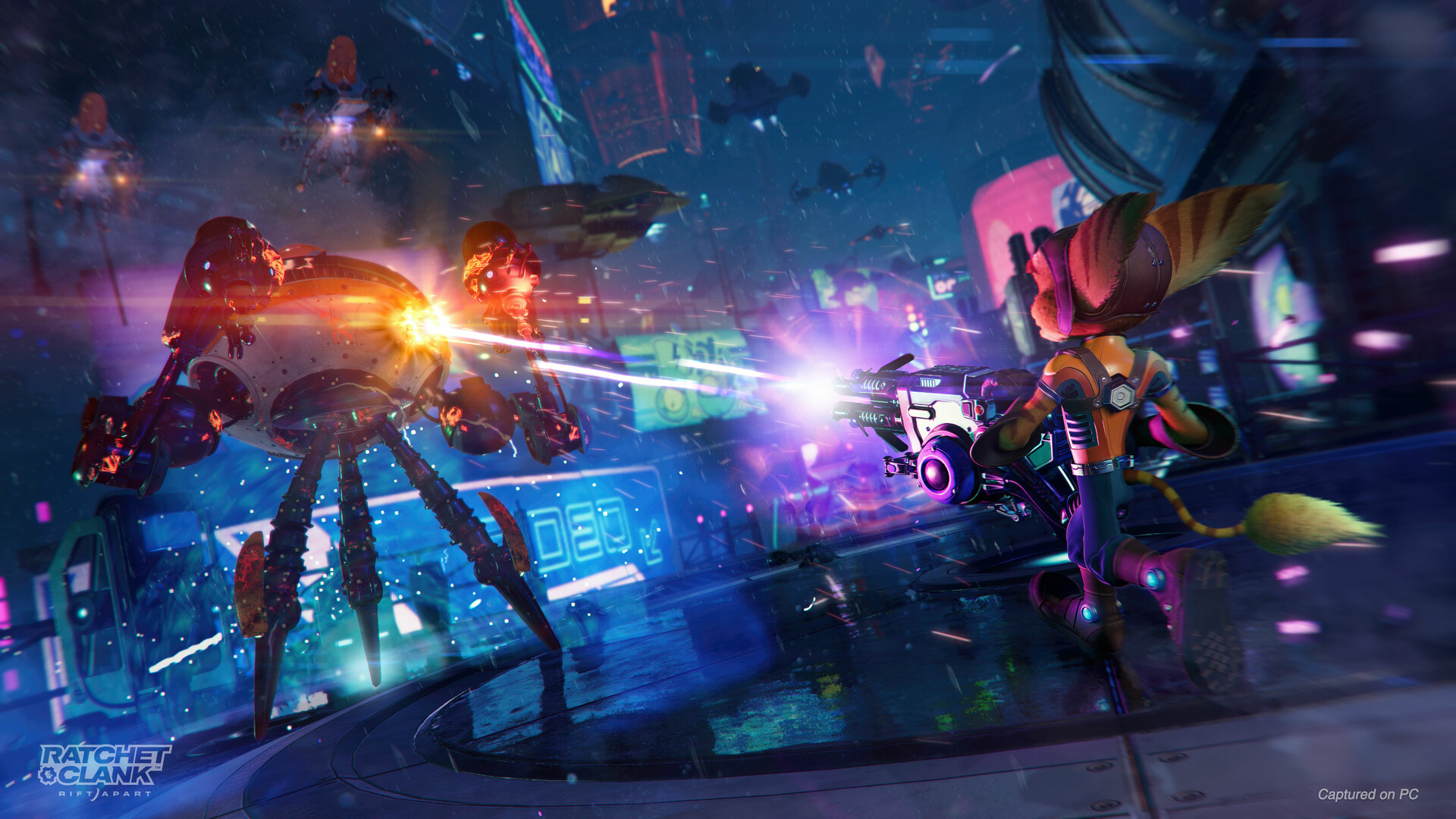
Platformer with dimension-hopping — PC port with DLSS 3. Use the resolution tabs below to see estimated hardware for a steady 60 FPS. Ray tracing is supported — use the toggles below to compare specs with RT on or off. GPU is usually the first component to upgrade for higher resolutions.
Test preset
Ultra baseline — use Low–Ultra toggles below, prioritize stable frame pacing over max eye candy; ray tracing off unless noted in the RT tab
Upscaling
DLSS 3, FSR 2
Hardware by target FPS
Pick a resolution, 60 or 120 FPS target, quality preset (Low–Ultra), upscaler (Native, DLSS, FSR, or XeSS), upscaling quality when applicable, and ray tracing — specs update to match. Minimum gets you close to your target; recommended holds it with headroom.
1080p · 60 FPS · High · Native · Ray tracing off
High preset, stable frame pacing preset, ray tracing off, Native
GPU-focused estimates for Ratchet & Clank: Rift Apart at 1080p, 60 FPS, ray tracing off. Based on moderate demand tier and typical platformer workloads — verify against your in-game settings. Hardware adjusted for high preset.
Graphics card
Minimum
GTX 1050 Ti 4 GB / RX 560 4 GB
Recommended
GTX 1650 Super 4 GB / RX 5500 XT 4 GB
Processor
Minimum
Ryzen 5 3600 / Intel Core i5-10400
Recommended
Ryzen 5 5600 / Intel Core i5-12400
Memory
Minimum
16 GB (dual-channel)
Recommended
16 GB (dual-channel)
16 GB prevents stutter when multitasking or using mods.
Storage
Minimum
50 GB SSD
Recommended
50 GB NVMe SSD
SSD recommended for faster load times.
Optimization tips
· Drop shadow quality or volumetric effects first if FPS dips below 60.
· At 1080p, lower post-processing before touching texture quality.
· Close browser tabs and overlays — 16 GB RAM fills quickly in modern AAA games.
Performance notes
· Ray tracing needs an RTX 20-series or newer (NVIDIA) or RX 6000-series or newer (AMD) GPU and DirectX 12 on most titles.
· Stable 60 FPS keeps platforming and QTE sequences responsive.
· Art-heavy titles may look great on modest GPUs when shadows and anti-aliasing are tuned down one step.
· 16 GB dual-channel RAM is recommended for all modern PC games; 8 GB is only viable on lighter titles.
· An SSD reduces load times; NVMe is helpful but not required for most single-player games.
What affects performance
GPU (primary)
Resolution, texture quality, shadows, and ray tracing scale directly with GPU power. Upgrade here first for higher resolutions.
VRAM
Higher resolutions and texture packs need 8 GB minimum, 10–12 GB for 1440p/4K Ultra. Ray tracing adds VRAM pressure.
CPU (secondary)
Most titles are GPU-bound, but dense cities and simulation workloads can stress older CPUs.